How AI-Powered Clash Detection Is Changing BIM Coordination
Jul 13, 2026
Category: Industry Trends
SEO TSA
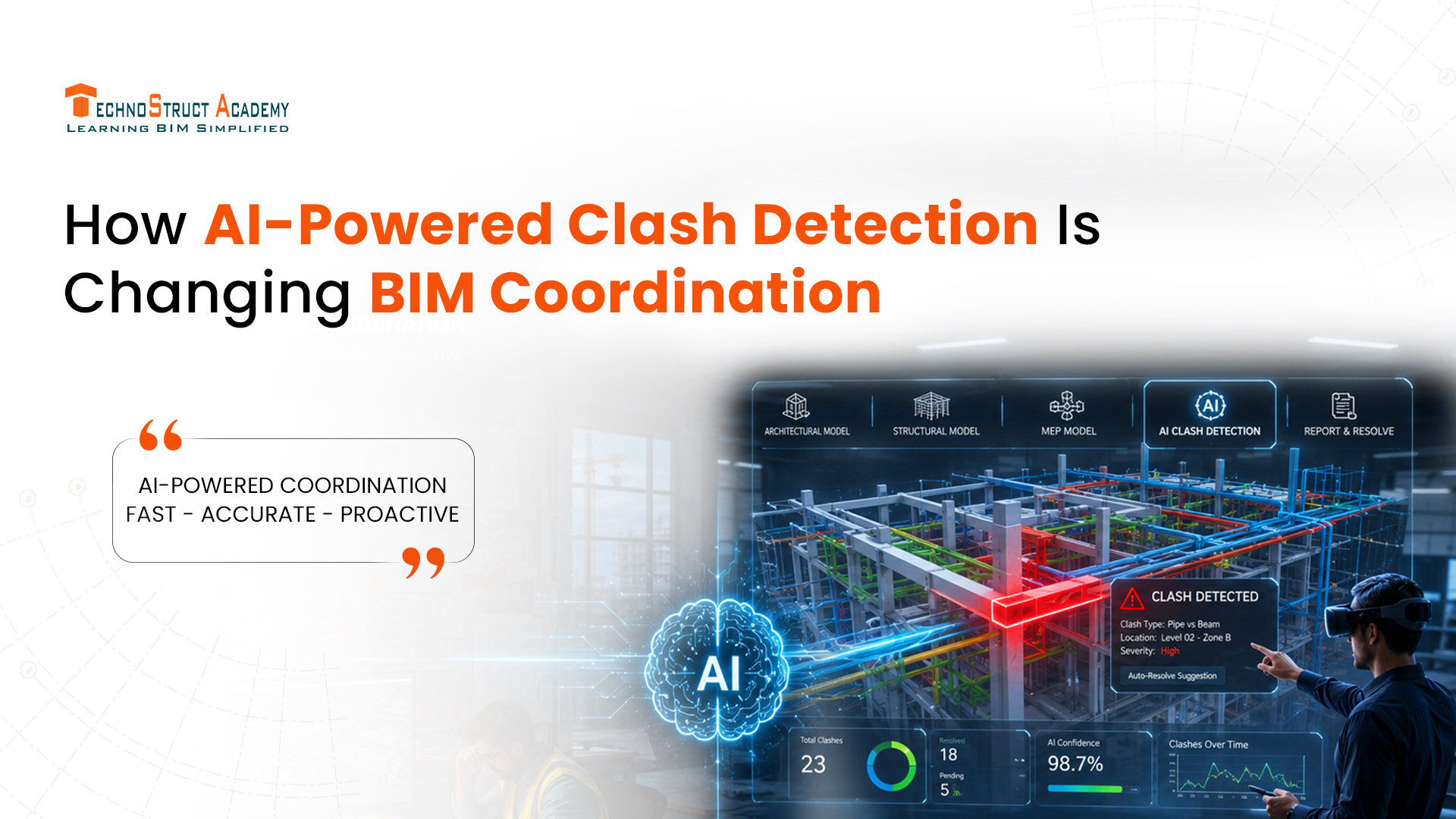
The construction industry has embraced Building Information Modeling (BIM) to improve collaboration, reduce project risks, and deliver buildings more efficiently. Yet one of the biggest challenges in BIM coordination remains identifying and resolving clashes between architectural, structural, and MEP models.
Traditional clash detection tools have significantly improved coordination, but they still generate thousands of clashes that require manual review. Today, Artificial Intelligence (AI) is transforming this process by making clash detection faster, smarter, and more accurate.
AI-powered clash detection doesn’t just find clashes—it helps teams prioritize, classify, and even recommend solutions before construction begins.
In this guide, we’ll explore how AI is changing BIM coordination and why it is becoming an essential part of modern construction workflows.
What Is Clash Detection in BIM?
Clash detection is the process of identifying conflicts between different building systems within a BIM model.
For example:
- HVAC ducts intersecting structural beams
- Electrical conduits passing through concrete columns
- Plumbing pipes conflicting with cable trays
- Fire protection systems interfering with ceiling layouts
Detecting these issues during design helps prevent expensive changes during construction.
Traditional BIM tools such as Autodesk Navisworks and Solibri identify these conflicts by comparing model geometry. However, these tools often produce thousands of clashes, many of which are irrelevant or duplicate issues.
This is where AI changes the game.
What Is AI-Powered Clash Detection?
AI-powered clash detection uses machine learning and intelligent algorithms to analyze BIM models beyond simple geometry.
Instead of flagging every possible intersection, AI can:
- Identify critical clashes
- Ignore duplicate or insignificant clashes
- Predict constructability issues
- Prioritize clashes based on project impact
- Suggest possible resolutions
- Learn from previous project decisions
Rather than replacing BIM coordinators, AI acts as an intelligent assistant that speeds up decision-making.
Why Traditional Clash Detection Has Limitations
Traditional workflows often involve:
- Thousands of clash reports
- Manual filtering
- Duplicate issues
- False positives
- Time-consuming coordination meetings
- Human errors during review
Large infrastructure or hospital projects can generate over 50,000 clash results.
Reviewing every clash manually is inefficient and delays project delivery.
AI dramatically reduces this workload.
How AI Is Transforming BIM Coordination
1. Intelligent Clash Prioritization
AI ranks clashes based on:
- Safety impact
- Construction sequence
- Installation feasibility
- Cost implications
- Project phase
Instead of reviewing thousands of clashes, BIM teams focus on the most critical issues first.
2. Reducing False Positives
Not every intersection is actually a problem.
For example:
- Flexible ducts touching insulation
- Pipe clearances within acceptable limits
- Minor overlaps allowed by design standards
AI learns project rules and filters unnecessary clashes automatically.
This reduces coordination time significantly.
3. Predictive Clash Detection
AI doesn’t only detect existing clashes.
It predicts potential conflicts before disciplines complete their designs.
For example:
- Space shortages
- Congested ceiling zones
- Equipment access issues
- Future maintenance conflicts
Predictive analysis enables proactive design improvements.
4. Automated Clash Classification
Instead of manually categorizing clashes, AI automatically labels them as:
- Structural
- Mechanical
- Electrical
- Plumbing
- Fire Protection
- Architectural
It can also assign priority levels and responsible teams.
5. Faster Coordination Meetings
Instead of discussing thousands of clashes, AI-generated reports provide:
- High-priority issues
- Root causes
- Suggested solutions
- Responsible disciplines
Coordination meetings become shorter and more productive.
6. Learning from Previous Projects
Machine learning improves over time.
If a company consistently resolves similar clashes in a particular way, AI can recommend the same solution for future projects.
This creates standardized coordination workflows.
Benefits of AI-Powered Clash Detection
| Benefit | Impact |
|---|---|
| Faster clash reviews | Saves coordination time |
| Better accuracy | Fewer false positives |
| Reduced rework | Lower construction costs |
| Improved collaboration | Better multidisciplinary coordination |
| Smarter decision-making | Prioritized issue resolution |
| Higher project quality | Improved constructability |
| Increased productivity | More efficient BIM teams |
Popular AI-Enabled BIM Platforms
Several BIM solutions are integrating AI capabilities into coordination workflows:
- Autodesk Construction Cloud
- Autodesk Navisworks
- Solibri
- Revizto
- Bentley iTwin
- Trimble Connect
- NVIDIA Omniverse for AEC
These platforms combine cloud collaboration with AI-driven analytics to improve model coordination.
Real-World Example
Imagine a 40-story commercial building with:
- Architecture
- Structure
- HVAC
- Electrical
- Plumbing
- Fire Protection
Traditional clash detection identifies:
18,000 clashes
After AI filtering:
- 14,000 duplicates removed
- 2,500 false positives ignored
- 1,000 low-priority issues deferred
- 500 critical clashes highlighted
Instead of spending weeks reviewing every issue, the BIM team can immediately focus on the clashes that matter most.
AI Is Not Replacing BIM Coordinators
A common misconception is that AI will replace BIM professionals.
The reality is quite different.
AI automates repetitive tasks, while BIM coordinators continue to make engineering decisions.
Professionals still need to:
- Evaluate constructability
- Coordinate stakeholders
- Validate AI recommendations
- Approve design changes
- Maintain BIM standards
AI enhances human expertise rather than replacing it.
Best Practices for Using AI in BIM Coordination
To maximize the benefits of AI-powered clash detection:
- Maintain high-quality BIM models.
- Follow standardized naming conventions.
- Implement ISO 19650 workflows.
- Keep model data updated.
- Use Common Data Environments (CDE).
- Train teams on AI-assisted coordination tools.
- Regularly validate AI-generated recommendations.
The Future of AI in BIM
AI is rapidly evolving beyond clash detection.
Future BIM workflows will include:
- Automatic design optimization
- AI-generated BIM models
- Real-time construction monitoring
- Digital twins with predictive maintenance
- Generative design recommendations
- Automated quality assurance
- Robotics integration
- Smart construction scheduling
As AI matures, BIM coordination will become increasingly proactive, enabling teams to prevent issues before they occur.
Conclusion
AI-powered clash detection is revolutionizing BIM coordination by moving beyond simple geometric conflict detection. It helps teams identify the most critical issues, reduce false positives, automate repetitive tasks, and make faster, data-driven decisions.
Rather than replacing BIM professionals, AI empowers them to work more efficiently and focus on solving complex engineering challenges. Organizations that adopt AI-assisted BIM workflows can expect improved collaboration, reduced project costs, and faster project delivery.
As the AEC industry continues its digital transformation, AI-powered clash detection is set to become a standard feature of modern BIM coordination, paving the way for smarter, more efficient construction projects.
Frequently Asked Questions (FAQs)
1. What is AI-powered clash detection in BIM?
AI-powered clash detection uses artificial intelligence and machine learning to identify, prioritize, and classify clashes in BIM models, reducing manual effort and improving coordination accuracy.
2. How does AI improve BIM coordination?
AI filters false positives, prioritizes critical clashes, predicts potential conflicts, and automates clash classification, enabling faster and more effective collaboration among project teams.
3. Which software supports AI-powered clash detection?
Leading platforms include Autodesk Construction Cloud, Navisworks, Solibri, Revizto, Bentley iTwin, and Trimble Connect, with AI capabilities continuing to expand.
4. Will AI replace BIM coordinators?
No. AI supports BIM coordinators by automating repetitive tasks and providing insights, while human expertise remains essential for engineering judgment, coordination, and decision-making.
5. What are the benefits of AI-powered clash detection?
The main benefits include reduced rework, faster project delivery, improved model accuracy, better collaboration, cost savings, and enhanced constructability.

Blog Categories